
From Log Deck to Load-Out —
What Happens Between Changes Everything.
Every sheet that leaves this plant has been pressed, calibrated, and documented to tolerances your engineering team can stake a project on. Walk the line.
Eight Checkpoints.
Zero Assumptions.
Every panel is the output of a documented production chain. The data below is the same data our QC team records every shift — not a marketing summary.
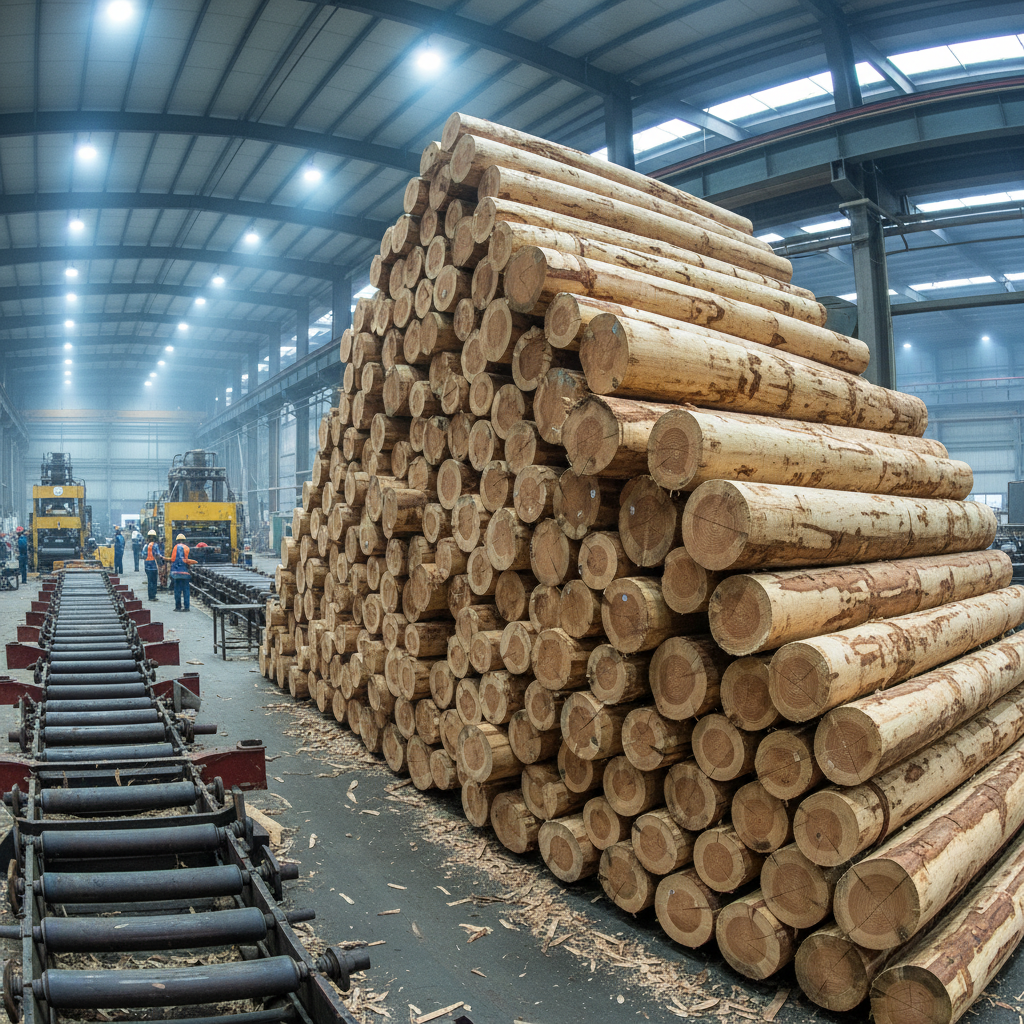
Log Preparation & Hydrothermal Conditioning
Logs are sorted by species and diameter, debarked to remove mineral residues, then soaked in heated water pools to soften fibers and reduce lathe checks during peeling.
| Parameter | Specification | Tolerance |
|---|---|---|
| Soak Temperature | 40 – 60 °C | ± 2 °C |
| Soak Duration | 12 – 48 hrs | Species-dependent |
| Log Diameter | 20 – 65 cm | Visual + caliper |
| Bark Residue | < 0.5% | Zero tolerance |
Rotary Veneer Peeling
Conditioned logs are chucked onto rotary lathes and peeled against a precision knife. Consistent knife angle and nose-bar pressure are the primary determinants of veneer quality.
Incorrect knife/nose-bar settings are the primary cause of lathe checks and split veneers. This checkpoint is audited on every lathe shift change.
| Parameter | Specification | Tolerance |
|---|---|---|
| Veneer Thickness | 1.0 – 3.0 mm | ± 0.05 mm |
| Knife Angle | 20 – 22° | ± 0.5° |
| Nose-Bar Pressure | 110 – 130 kPa | ± 5 kPa |
| Lathe Speed | 80 – 200 rpm | Log-diameter curve |
Clipping & Optical Grade Assessment
Green veneer ribbons pass through automated clippers that remove knots, splits, and edge defects. Optical scanners classify each sheet into grade bins before drying.
| Parameter | Specification | Tolerance |
|---|---|---|
| Knot Diameter (A) | 0 mm | None permitted |
| Knot Diameter (B) | ≤ 25 mm | Repaired flush |
| Sheet Width | 1,220 mm std. | + 5 / – 0 mm |
| Split Length | 0 (A) | Per grade table |
Veneer Drying
Green veneer enters continuous roller dryers at 160 – 180 °C. Exit moisture content is measured per sheet; off-spec sheets are re-dried or rejected.
| Parameter | Specification | Tolerance |
|---|---|---|
| Dryer Temp | 160 – 180 °C | ± 5 °C |
| Exit Moisture | 7 – 8 % | ± 1 % |
| Green MC Entry | 50 – 80 % | Species range |
| Warp Flatness | < 2 mm/m | Reject > 4 mm/m |
Adhesive Application & Cross-Grain Layup
Dried veneers are coated with resin by roller spreaders, then stacked in cross-grain orientation. Odd ply counts ensure balanced panels. Glue type is matched to end-use specification.
E0-grade UF adhesive used for interior applications. PF resin mandatory for exterior/structural grades per APA PS 1-19.
| Parameter | Specification | Tolerance |
|---|---|---|
| PF Glue Spread | 160 – 180 g/m² | ± 10 g/m² |
| UF Glue Spread | 140 – 160 g/m² | ± 10 g/m² |
| Open Assembly Time | ≤ 20 min | Gel test each batch |
| Ply Orientation | 90° alternating | Zero misalignment |
Hot Press Cure
Assembled panels load into multi-opening hot presses. Temperature uniformity across the platen is the critical variable — cold spots cause bond failures. Cycle time is controlled to prevent precure.
Panels failing platen temperature uniformity ±2.5 °C are quarantined for delamination testing before release.
| Parameter | Specification | Tolerance |
|---|---|---|
| Press Temperature | 120 – 150 °C | ± 2.5 °C |
| Press Pressure | 14 kg/cm² (200 psi) | ± 5% |
| Load Time | < 2 min | Hard limit |
| Full Pressure Ramp | < 60 sec | Hard limit |
Calibration Sanding & Edge Trimming
Post-press panels are trimmed to final dimensions and run through wide-belt sanders that calibrate thickness across the full panel width. This step eliminates veneer-to-veneer step variations.
| Parameter | Specification | Tolerance |
|---|---|---|
| Thickness Tolerance | Nominal ± 0.2 mm | APA PS 1-19 §5.3 |
| Surface Roughness | ≤ Ra 3.2 µm (A) | Ra 6.3 µm (B) |
| Panel Squareness | ≤ 1.5 mm diagonal diff. | Reject > 3 mm |
| Edge Straightness | ± 0.5 mm / 2,440 mm | Reject outside |
Final Grading & Mechanical QC
Every panel receives a grade stamp. Random-sample mechanical testing covers Modulus of Rupture, Modulus of Elasticity, and shear-through-the-thickness. Bond integrity is tested via the boil test for exterior grades.
| Parameter | Specification | Tolerance |
|---|---|---|
| MOR (Structural) | ≥ 24 MPa | Batch average |
| MOE (Structural) | ≥ 9,500 MPa | Batch average |
| Bond Shear (PF) | ≥ 1.0 MPa post-boil | Per APA PS 1-19 |
| Formaldehyde (E0) | ≤ 0.05 ppm | CARB P2 limit |
Filter Before You Commit.
Narrow by thickness, grade, and application. Preview the data sheet before requesting the full PDF library.
Select a panel from the list to preview its mechanical properties and certifications.
The Stamps Your
Engineer Recognises.
Every certification below is current, auditable, and available in the spec sheet library. No expired badges, no placeholder logos.
Chain-of-custody certified. Every log traceable to a responsibly managed forest.
Structural plywood performance standard. All structural grades tested to PS 1-19 §5 MOR/MOE minimums.
California Air Resources Board Phase 2 formaldehyde compliance. Interior panels ≤ 0.05 ppm.
Near-zero formaldehyde emissions per JIS A 5908. Specified for schools, healthcare, and residential interiors.
Quality management system certified. Every production batch is documented and traceable by date and press ID.
Spec Comparison Matrix
All six production SKUs side-by-side. Full version available in the library.
| Property | 9 mm | 12 mm | 15 mm | 18 mm | 19 mm | 25 mm |
|---|---|---|---|---|---|---|
| Thickness Range | 9 mm | 12 mm | 15 mm | 18 mm | 19 mm | 25 mm |
| Face Grade | A | A | B | B | C | C |
| Core Species | Birch | Poplar | Birch | Poplar | Softwood | Birch |
| Adhesive | E0-UF | E0-UF | E0-UF | E0-UF | PF | E0-UF |
| MOR (MPa) | 22 | 24 | 30 | 30 | 28 | 42 |
| MOE (MPa) | 8,200 | 9,500 | 9,800 | 9,800 | 10,500 | 12,800 |
| Tolerance | ±0.20 | ±0.25 | ±0.20 | ±0.20 | ±0.25 | ±0.15 |
| FSC | ✓ | ✓ | ✓ | ✓ | ✓ | ✓ |
| CARB P2 | ✓ | ✓ | ✓ | ✓ | — | ✓ |
| APA PS 1-19 | — | — | — | — | ✓ | — |
* Full spec matrix includes bond integrity, internal bond, surface soundness, and formaldehyde emission results by batch. Download below.
Download the Full
Spec Sheet Library.
Six SKUs. Twenty-two properties. Every certification current. The same binder our QC manager hands to incoming auditors — formatted for your engineering team.